Exceptional kidney advocate champions early diagnosis and organ donation
A kidney transplant recipient who spent ten years on dialysis, is now dedicating her time to spare others from a lifetime of challenging treatments.
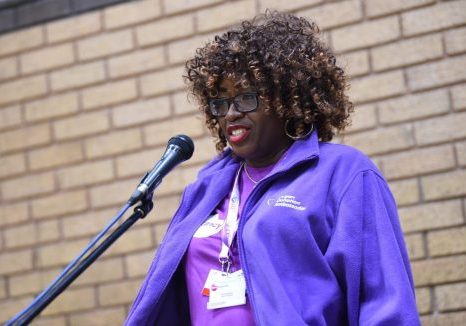
Hilaria Asumu, from Manchester, has made it her mission to raise awareness of kidney disease, becoming a community ambassador and blood pressure volunteer with Kidney Research UK.
Ever since receiving her own transplant in 2018, Hilaria has been raising awareness of the life-changing impact of organ donation, encouraging people to consider becoming donors.
Following dedicated training from Kidney Research UK, she also offers free blood pressure checks in her community, helping people to understand if they are at risk of kidney problems and encouraging them to seek healthcare that could lead to an early diagnosis. This is vitally important, as high blood pressure can both increase your risk of developing kidney disease and be a sign of kidney disease itself. Identifying problems before someone reaches kidney failure could delay or even remove the need for dialysis or a transplant.

Hilaria, 53, says: “I come from Nigeria originally and we don’t tend to speak about illness or death. Becoming an organ donor is not a topic that is often considered, meaning there are a lack of donors from the Black community. That’s why it is important to me to share my story, to encourage people to think differently.
“People in my community, especially men, are reluctant to visit the doctor when they are concerned about their own health. A lot of people have family living abroad, meaning they are financially supporting extended family, in addition to their own household. There is a pressure to avoid being unwell or visiting the doctor.
“It means kidney disease often goes undiagnosed until people’s kidneys have failed and dialysis or a transplant is needed. That’s why I regularly go to community events and places like churches, mosques or the local supermarket, to take health information and carry out blood pressure checks for people who may not seek it out themselves.
“If we can identify people’s high blood pressure and encourage them to see their GP and get an earlier diagnosis, it means steps can be taken to protect their kidneys. It is an amazing thing to be a part of.”
Hilaria’s story
Hilaria is all too familiar with the harsh realities of kidney failure. When she had a miscarriage at 22 weeks pregnant in 2008, she was rushed to hospital by her husband. She woke up in intensive care to find that she had been in a coma, having experienced two cardiac arrests, multiple organ failure and septicaemia (a serious infection of the bloodstream).
Hilaria says: “It was completely disorienting. I couldn’t understand where I was or what was happening. I don’t have a family history of health problems and I had been perfectly fine until this time. To be told I had kidney disease was devastating. We were all crying and wondering what it would mean for my life.”
Hilaria needed emergency dialysis which helped her kidney function bounce back. However, in 2010 another miscarriage left her in a second coma with septicaemia and a collapsed lung.
Hilaria says: “My husband was told that if I didn’t come out of my coma by a certain date, that they would have to turn off my life support machine. Amazingly, I woke up on the day they were going to do that.
“I’d survived, but this time I was told I’d need dialysis until a transplant became available. That took ten years because I had a high level of antibodies, making it difficult to find a match. None of my family were able to donate and I thought my life was over. I cried every day because I hated dialysis. It restricted my life a lot.”

Receiving a transplant
After a decade of waiting, Hilaria finally received the phone call she had been yearning for – to tell her a kidney had been found.
Hilaria says: “I felt every emotion. I was stunned, excited and euphoric. I didn’t know what to say or what to do. All I heard was that I needed to get to hospital. Waiting so long had caused me to lose my faith. I’d prayed, begged and promised. Nothing was working. I thought God had abandoned me. That day I got my faith back.”
“Once I’d had the transplant it felt like this huge cloud had gone. I no longer needed dialysis and could get back to my life: being a mum to my two children, travelling and enjoying life, without being attached to a machine. I can’t describe the joy. It’s hard to put into words just how grateful I am to my donor and their family.”
Becoming a volunteer
Hilaria immediately wanted to make a difference for others, becoming an ambassador for NHS Blood and Transplant (NHSBT) and Kidney Research UK.
She says: “I wanted to give back and talk to people in my community. I love sharing my story. I regularly go to churches and mosques to speak about my experiences. I even got permission from my local ASDA to speak with customers over the tannoy system. It’s rewarding to build an understanding of kidney disease, that hopefully means more people will receive an earlier diagnosis or consider organ donation.
“When Kidney Research UK developed the blood pressure volunteering role, I was so keen to be involved. People are often surprised if their blood pressure shows as being high. I’m not a doctor, but I can recommend people see their GP and provide information to support them in looking after their health.
“I find volunteering so rewarding and there is still a lot of work to do. I’d love for more people to volunteer. You don’t need any experience – just passion! You will be supported by Kidney Research UK in your role. When you get into volunteering, you don’t look back. It’s so satisfying.”